Showing posts with label 2013. Show all posts

Sunday, 7 September 2014

Primer: Essential Marvel NOW!

Marvel NOW! has impressed me. Marvel has come out with some lackluster books, but I feel the NOW! initiative has reinvigorated things and have allowed for new narratives to be told, books I never thought would exist to exist and give some new blood we wouldn't have had before that give books an independent identity.

For new readers and for old, here is my list of the best books to read out of the NOW! initiative.

Avengers/New Avengers by Jonathan Hickman
I'm of the opinion that Bendis' Avengers devolved from a great concept into prolonged stories full of double-page spreads and not a lot of story. After the first volume of New Avengers, not a lot of good happened.

Hickman is hitting it out of the park. He's expanded the Avengers roster into an international team with a lot of new members, and into intergalactic space sagas like Infinity. New Avengers is given a much more interesting concept than we had before - rather than the lower-tier Avengers who live at Avengers Mansion, it's the Illuminati who are trying to prevent the destruction of Earth. Hickman explored the alternative universe concept in Fantastic Four, and this is an extension of that theme - but in a much more central way which grounds both books in a long-term plan which will end in the incursion: either "everybody dies" immediately, or another earth is destined to die,

Uncanny Avengers by Rick Remender
We started off with a good arc, with art by John Cassady, which pitted the newly formed Avengers Unity Squad against the 1942 clone of the Red Skull.

Then we had some interesting mutant politics, with Havok (an awesome inclusion to the team) asking to the press "Call me Alex."

But what follows is an amazing multi-volume arc picking up on threads from Remender's Uncanny X-Force, and going ahead and destroying the Avengers, in many literal senses. Oh, and we get the heroes of 2020 in there too (and let me tell you, Iron Man 2020 is always a positive.) With a roster with female heroes like Rogue and Scarlet Witch, given some awesome new costumes, Remender has created the perfect blend of the Avengers and the X-Men in one book. Acuna is reunited with Remender in art, and it is perfection. As much as I love Cassady, Acuna gives the book a really great and epic feel. It's all but been confirmed that the book is ending within a couple of issues, but damn, what a ride it's been.

Young Avengers by Kieron Gillen and Jamie McKelvie
I LOVE THIS BOOK AH. I mean, I already loved the Young Avengers before going into this. It screams: go read Phonogram. Go read WicDiv next year. Look at McKelvie's prettiness in Suburban Glamour.

It's experimental, with brief arcs and overarching themes and some interesting panel layouts. It's teenage. The art is very very pretty. It explores everything from parental relationships, good and evil, sexuality, awesome music choices, and also the manipulations of Loki and eating at breakfast bars.

It's 15 issues (being collected in Omnibus form), but to paraphrase Gillen, "this book is so last year." And in a good way.

Avengers Arena by Dennis Hopeless
Ex-Runaways and Avengers Academy members in Lord of the Flies/The Hunger Games/Battle Royale vs. Arcade. What's not to love?

All-New X-Men #1-15 by Brian Michael Bendis
All-New X-Men now seems to have fallen into the standard Bendis trap: extended decompression which just ends up either making everything unreadable, or a 5 minute read. I enjoyed the [I]Battle of the Atom[/I] crossover storyline, but sadly All-New has failed to pick-up since then (although The Trial of Jean Grey was decent.)

It's kind of what we saw in the Days of Future Past film, really. Our present is the dystopia. It's not an explict dystopia with mutant camps, fire and lots and lots of dead people, but following events like House of M and AvX, it's hard not to view the (glamorous in looks, not in events) present in that light. It's a subversion of the typical idea of time traveling forward to the future, which I like. Instead, Hank McCoy removes the original X-Men from the past to try and prevent the past, what has already happened for both the reader and the characters in the X-books. It develops naturally, there's questions of paradoxes and also what year the X-Man exactly came from, with controvesies over the existence of bottled water and the development of Times Square - standard 'fish out of water' stuff. Plus it feels like the most natural way of reintroducing Jean Grey to the present books, without forcing a resurrection in there.

Uncanny X-Men by Brian Michael Bendis and Chris Bachalo
Uncanny X-Men, in contrast, has remained great. It continues the Schism idea of a split X-Men, but this time it's more villainous, with Cyclops, Magneto, Emma Frost, Magik (a character I absolutely adore) along with some new mutants. Chris Bachalo's art is awesome, and I honestly feel this is the X-book everyone should be reading right now. Even the Original Sins tie-in has introduced a thought-provoking addition to Xavier's history, with some sweet moments with She-Hulk and Nightcrawler too.

X-Men by Brian Wood
X-Men has struggled to find its place as a title in the last couple of years. But Wood is able to craft all these great characters where the female side of the X-Men is represented as their own group. Jubilee is the best she's been in ages, given an awesome role as mother. Storm is great, Rogue is great, Psylocke is great... it's great. The middle arc dips a little, but the first and third arcs are both excellent explorations of a corner of the X-Men which has been somewhat sidelined. Storm's daughter from the future, Kymera, is in the third arc and makes everything worth it.

Amazing X-Men: The Quest For Nightcrawler by Jason Aaron
Resurrections are hard to deal with. It's such an overused conceit in comic books that it hardly lacks worth. But Aaron makes it unique: Nightcrawler is literally yanked from Heaven. Literally. Azazel may not have sat right in Chuck Austen's best forgotten run, but here Aaron uses a forgotten piece of canon to an advantage. It makes a perfect exploration of Nightcrawler, his faith and ancestry, but also of the nature of comic book resurrections.

Nightcrawler by Chris Claremont and Todd Nauck
Chris Claremont writes a good book in the present day for once. Who knew? In places, it reeks of nostalgia. But Claremont brings good old fashioned adventure that doesn't feel out of place; Claremont doesn't smother us with over-wrought narration either. At the same time - in really an extension of those first six issues of [I]Amazing X-Men[/I] - he looks at Kurt's faith and also that revolving door of resurrection. It's really cool to see Kurt back in his place, now at the Jean Grey School. Plus, you get to see Kurt back in Deutschland again, something everyone can appreciate.

Magneto by Cullen Bunn
Cullen Bunn isn't a writer I like. Yet somehow, he gets to write a book with what is essentially a villain killing people with metal and making it a good book. There's reference back to the Nazis (not the Holocaust, but events outside of Max's life in the camps - a story Greg Pak told exceptionally well in Testament, but Bunn gives us different pieces to the puzzle) but also Magneto's life with and against the X-Men. He is this lone force, much as we saw him in X-Men: First Class, acting outside of the helmet for a lot of the time. His powers have weakened and he's adjusting to that life. And I love this book.

Storm by Greg Pak and Victor Ibanez
Two issues in, and I'm already in love. Storm, with her punk mohawk and her powers of the sky has captivated me. This book balances everything great about Storm - her African heritage, her life with the X-Men, her relationship with Wolverine, her punk nature, and merges it into this conglomeration of all these different elements. A characterisation which shows she is powerful yet can misjudge things, and also judge things correctly. She gets to pair off with Beast, and it's all wonderful to see. Plus the art is a thing of beauty.

It's impressive. It really is impressive.

Savage Wolverine
I've never really loved Wolverine, and in its initial concept as an anthology book Savage Wolverine didn't really book. But whenever it delves back into history, it's great. From #9 onwards, we explore Logan in World War One, the Prohibition Era, the Kennedy assassination, and all this links together to make this great little book outside of the present day but establishing its own stuff. Cornell's stuff isn't as much to my taste, but this book gives us a feral Wolverine at his best.

Captain America: Castaway in Dimension Z by Rick Remender and John Romita Jr.
I'll admit, I'm excited for Sam Wilson to take on the mantle of Captain America. I like the idea that Cap has lost the effects of the serum and is now a very good looking 90 year old. But the readability of the book has been pretty weak recently.

What Remender did well, though, is in his introductory arc. We get to see Steve's growth during the Depression juxtaposed against a Cap stranded in another dimension - the dimension of Arnim Zola. It doesn't compare against Brubaker's run, sure, but it doesn't need to. It sets up its own story, one which I wish had played out better. But, as it introduced itself, it makes for a fulfilling read.

Indestructible Hulk #1-5 by Mark Waid
How far have we fallen. Waid sets up a great new status quo - Banner would be controlled as the Hulk, he'd get a new haircut, he'd work for SCIENCE! at S.H.I.E.L.D. It's gone almost as soon as it started. The first volume is a great exploration of Banner, along with a team-up with Iron Man. Soon the run descends into silly time travel stories, Banner losing his intelligence and now a new title written by Gerry Duggan which doesn't seem great. Hulk is one of the big (not literally big, although that also works) characters who has struggled to get a series which lasts or has much of a legacy. But heck, that armour was cool and Hulk and Maria Hill's interactions are fun to see.

Thor: God of Thunder by Jason Aaron
I find Thor hard to get into. With literally millenia of mythology, he's the least down-to-earth character out there buckled up with the history of Asgard. Aaron embraces that history and mythology that has made me hesitant on Thor before and given us a saga that spans from the Dark Ages to the end of time. This is how to write Thor. Every issue in this series and I can't say there's a bad one. He explores Thor's home in Broxton; he explores Thor's destiny yet to come, and Jane Foster plays a (non-romantic) role too, like she did in Fraction's run. Esad Ribic's art helps a lot, too.

The Superior Spider-Man by Dan Slott and Humberto Ramos
The Amazing Spider-Man is terrible. But before Slott returned Peter to his normal self, we had a 31-issue run with subverted a hero into a villain. Not everything worked perfectly, but what Slott did here is miles ahead of what he's doing now.

She-Hulk #1-4 by Charles Soule and Javier Pullido
Soule, a lawyer, goes ahead and writes a book about a lawyer who isn't Catholic, isn't blind and isn't male either. I've always had an affinity for She-Hulk - Sensational is a favourite of mine - but to see Jennifer return to an independent attorney role, setting up her own business for people with powers (and people without powers, too.) It's kinda the She-Hulk and Hellcat team-up book, and that's okay. I love seeing these one-shot cases being tackled. The quality has dipped - #5-6 was basically no-one's cup of tea with fill-in art, and I really wasn't feeling the Ant-Man story (#7), but I'm hoping everything will return to the awesomeness of those initial 4 issues.

Black Widow by Nathan Edmonson and Phil Noto
Edmonson gives Natasha both S.H.I.E.L.D. and a cat, and it works perfectly. And boy, can Phil Noto draw action - which each issue relies quite heavily on. The series crosses the globe, and we end up with some "Natasha vs. her ex-boyfriends" issues - namely, Daredevil, Hawkeye and the Winter Soldier, and it works perfectly.

The Punisher by Nathan Edmonson
Frank moves to L.A., adopts an intriguing new armoured costume and hangs out with a cop. I love Frank's alignment to the police, firstly because he's so anti-law in the first place and secondly because it gives me flashbacks to the 1989 film where Frank is an ex-cop hunted by the cops, a film which I also love.

Ms. Marvel by G. Willow Wilson
I never expected to absolutely adore a book about a 16-year old Muslim girl, but apparently I do. It's not a culture I know or understand well at all, but it's seen through the prism of a teenager growing up and carrying the mantle of a hero - one of which I can relate to, and the other being something I like. Congratulations to Wilson, because this beats my previous experience with Muslim culture - which is EastEnders subplots.

Captain Marvel by Kelly Sue DeConnick
DeConnick takes Carol on the next logical step - into space. Her first run gave a Carol grounded on earth - or at least our own atmosphere - but, as many arugments as I have for relaunching again, this sets itself apart from that by taking her to the stars. As much as her being with the Guardians doesn't sound like a good idea, this isn't about her with the Guardians. This is her on her own, kicking butt. We get an alien lesbian couple to, which was such an adorable scene and I appreciate seeing a little hint of more diversity.

Moon Knight by Warren Ellis and Declan Shalvey; Brian Wood
I've seen people say they're jumping off this title because Warren Ellis is gone. I say don't. The awesomeness of this book extends beyond Ellis' writing and Shalvey's unique, minimalistic panel layouts. Moon Knight has become this silent speaking badass, going up against criminals of any sort. It's an action book primarily, and whilst each issue is light on exposition and dialogue and is a breeze to get through, it's a lot more fulfilling of a breeze than, say, the breeze of a Brian Michael Bendis book of the worst sort.

Silver Surfer by Dan Slott and Michael Allred
It's a nostalgic book, where we see Earth 13 years ago held by Galactus, we meet our Defenders buddies, Hulk and Strange, again, and everything from the lack of cellphones to Allred's art evokes that era. But fundamentally it's a story of the Surfer and a human woman in her 20s, who is not the romantic lead nor is magazine cover attractive. She's a down-to-earth woman who still operates in the vicinity of parents and is about to become, well, literally not-on-earth. Not sure how this book has been selling but I really hope it sells well, because damn. Slott may be terrible on Peter Parker right now but I am loving his work on Norrin Radd.

Loki: Agent of Asgard by Al Ewing
Young adult Loki, the internet, All-Mothers, reincarnated Asgardians and Al Ewing. 'Nuff said.

Rocket Raccoon by Skottie Young
The best of the solo-Guardians books, with a distinct light-hearted tone and a lot of fun. And Groot.

Spider-Man 2099 by Peter David

The best Spider-Man book right now, where Miguel O'Hara adapts to the present day knowing full well he might destroy his own present day in the process. A lot of fun and the best Miguel has been written since the 90s (by the guy who wrote him in the 90s, of course.)

Sunday, 27 April 2014

Winter Soldier: The Electric Ghost (#15-19)

Writers: Jason Latour and Nic Klein

Cover artists: Declan Shalvey and Nic Klein (#15-16), Declan Shalvey and Chris Brunner (#17), Nic Klein (#18), Declan Shalvey (#19)
Variant covers by Nic Klein (#15), Mike Deodata (#16), Chris Brunner (#17), Dave Johnson (#18) and Jason Latour (#19)
Collected in:
  • Winter Soldier: The Electric Ghost (Marvel Comics, Aug 20th 2013)
  • The entire series is available on Marvel Unlimited and Comixology.
Sketch by Latour

Sketch by Shalvey
Sketch by Klein
Art by Klein


#15 "Skin to Shed"


      Continuity Notes


-        Since Black Widow Hunt, Bucky's hair has grown out.

-        Throughout the run, Bucky refers to his "summer protocols" - in contrast to Brubaker's run, presumably placing this within the summer.

-        Bucky recalls a moment from his Soviet history:
      "One afternoon in 1977 [the Croatian] Colonel Rajko led his forces against the fascist Soviet occupation. All told I killed nearly 50 of his men that day. Three of his brothers among them."At the beginning of this story, he has returned to Croatia to atone for these actions."I had to tell him. His men came at me before I could think."
-        Fury meets with Bucky, presumably for the first time since the last story. "This little crusade of yours, runnin' 'round confessin' your sins? It's got the new S.H.I.E.L.D. brass more than a little jumpy." Fury has been underground since the end of Battle Scars, where his son, Nick Fury Jr., found a place in S.H.I.E.L.D. (literally) in his father's name.

-        Bucky says that "by the time" he and Steve first met, "the army had taught me to speak six languages. And twice as many ways to kill a man with my hands. The kid he remembers never even existed. No one's ever been able to see that. No one but Natasha." He maintains that "I don't belong at S.H.I.E.L.D. without her."

-        Fury tasks Bucky to go after Joe Robards, a S.H.I.E.L.D. agent at "the top of Fury's list": a man who went undercover into Hydra "30 years" ago, "in 1982." "The sole tether to his old life was his handler [and lover], an agent named Gina Autry." Bucky recalls:
      "That same year I was tasked with the recovery of a defecting Soviet physcist-- Dr. Linus Tarasova. Agent [16,] Autry[,] was my opposite number. Tasked with Tarasova's extraction to the west. Gina Autry died on a snowy hill in Latveria. She died defending Dr. Tarasova from me."
-        We flashback to the previous night, "18 hours ago," where Robards finally breaks his cover after "over 30 years," shooting almost all of the customers at a Hydra-run casino.

      #16 "Closer Than Enemies"


      Continuity Notes


-        This and the following three issues feature flashbacks to Bucky's mission with Gita in 1982, which he referred to last issue. Here, Bucky is working for one Colonel Conrad Petrov ('Father Hammer') - a man who "scurried from the wreckage" after the fall, and created 'The Orphanage', a top secret Hydra-run organisation which trained children - "[stolen] from their beds in the night" - into professional killers.

-        Bucky visits Natasha's Paris safe house, where Robards has been laying low. He says that she "hasn't been here in months." Unless I'm mistaken, Natasha last visited Paris in the one-shot Fear Itself: The Black Widow. He says that Robards has been "A.W.O.L. for weeks" since his outburst at Hydra last issue.

      Pop Culture


-        Maria Hill refers to a "Steranko class satellite" which vanished two days ago. This is clearly an
      homage to Jim Steranko, the artist who revolutionised comic book art, and S.H.I.E.L.D. as an entity in itself, through his work on Strange Tales/Nick Fury, Agent of S.H.I.E.L.D., working as both writer and artist in an unusual move. Indeed, if not for Steranko, S.H.I.E.L.D. may not have remained as powerful a concept as it is today. Steranko's entire work on Nick Fury is available in a Complete Collection, released in 2013.

-        Fury jokes "Used to be a fella would at least offer a glass of toilet wine before a prison hug. I guess bromance really is dead."

      #17 "A Dark and Heavy Star"


      Continuity Notes


-        Fury mentions that "the Van Allen [radiation] belts" is the "same place that created the Fantastic damned Four," i.e., the spatial place inundated with cosmic rays. Per Wikipedia, it is "one of at least two layers of plasma that is held in place around the planet Earth by the planet's magnetic field." So far as I'm aware, the Fantastic Four's (particularly unscientific) origin has not been referred to in such scientific detail before.

-        The Electric Ghost (Tesla Tarasova) is reunited with Bucky for the first time since her mission in 1982.

      Pop Culture


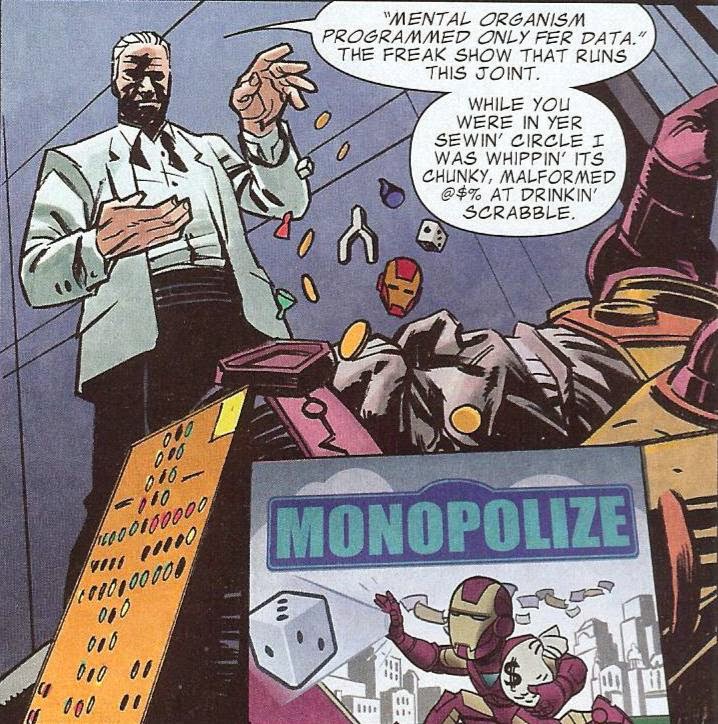
-        Amidst MOPOD is a rather amusing analogue to Monopoly: 'Monopolize' (or, according to Fury, "drinkin' Scrabble"), a game emblazoned with the billionaire Iron Man's likeness.

      #18 "The Phantom Limb Technique"


      Continuity Notes


-        In this issue and the next, we see several flashbacks to the Electric Ghost's history in the 1980s. This issue is largely a summation of that history. Following the mission to extract her father, Tesla had been "taken into the custody of the KGB" and sent to The Orphanage (#16). We open here with Tesla writing in her journal: 12th July 1984. She says "My first years at The Orphanage were spent in isolation." A few years later, "at 11 years old, she is "finally inserted into the student body": the age at which she murdered her dying friend, Alphonse, in the jungle, upon command: "That was the day Tesla Tarasova died her secret death." Having returned to The Orphanage, she pondered scientific questions: ""If" is at the core of "life." What, then, is the value of "if"?" She tried to escape, perhaps on numerous occasions, "but I didn't make it very far or last very long."  Following graduation, she was sold to one Van Owen and became his "chisel," working in a high position training children. Warren Van Owen's role as recruiter saw him as a covert, black level S.H.I.E.L.D. agent "funneling" members of The Orphanage into S.H.I.E.L.D. - a fact Tesla only discovered after his death on his own computer. By the late 90s, Tesla went rogue, pursued by sleeper agents and murdering Van Owen. She became driven by the Winter Soldier's visit in 1982, unable to recall her "father's face." By the 2000s, "all I had was my father's work": an essay on cosmic rays - concepts she put to use in her own Electric Ghost technology. She is reunited with Father Hammer. He says:
      "Your mother died screaming as we ripped you from her womb. So too did your father as he tried to rip you from our arms. He died on my order. At the hand of my assassin, the Winter Soldier."
-        The Electric Ghost notes Bucky's costume redesign, seen since #15: "[You had] a widow of your own. And you wear this to mourn her? A black star?" Throughout Brubaker's run, the Winter Soldier of the modern era has been seen with a white star, encircled by blue and red - creating, in effect, the colours of the American flag and the shape of Cap's shield. In his current appearances in All-New Invaders, he still has the black star: although he has dropped the red circle and long hair.

      #19 "It Ends With a Kiss"


      Continuity Notes


-        Fittingly, this issue opens with a pop-art recreation of Bucky's 'death' from Avengers #4, descending from Zemo's plane into the Atlantic Ocean. He recalls words his father told him shortly before his death: "It's the soldier next to him he fights for." Bucky concludes: "Those words that have rung in my head my entire life. Even when I couldn't recall where they'd come from."

-        This issue occurs immediately following the last, with Tesla kissing Bucky.

-        She refers to the object she calls, which resembles a Cosmic Cube, as the 'Tarasova Tesseract.' Clearly, this is a reference to the MCU equivalent of the cosmic cube. She calls it "Such a brightly burning star--turned inward on itself" - not "power for the sake of power" like the Cosmic Cube.

-        Tesla physically takes Bucky through her history, seen in last issue, through the power of the Tarasova Tesseract.

-        Gina's file says she died 09/04/83, contrary to the year given in #15. Robards recalls: "I hadn't talked to Gina in months when she died. Not really. Not since the day I'd asked Fury to put me back undercover--"

-        We are given a somewhat optimistic ending: Bucky touches the Tarasova Tesseract, and is briefly transported back to his time with the Black Widow, represented by the blue, white and red symbol on his robotic arm, where, in accordance with the issue's title, they kiss.

Saturday, 26 April 2014

Winter Soldier: Black Widow Hunt (#10-14)

Writers: Ed Brubaker and Butch Guice

Cover artists: Steve Epting (#10-13) and Dañiel Acuna (#14)
Collected in:
  • Winter Soldier: Black Widow Hunt (Marvel Comics, Apr 2nd 2013)
  • Winter Soldier by Ed Brubaker: The Complete Collection (Marvel Comics, Sep 23rd 2014)
  • The entire series is available on Marvel Unlimited and Comixology.

-        This arc carries directly on from the previous, and marks the end to Brubaker and Guice's tenure on the title - and for Brubaker, his time at Marvel - having been with the company since the 2004 Captain America relaunch, and worked on such titles as Daredevil and Immortal Iron Fist. In a CBR interview, he said that "sales weren't as good as we'd hoped they'd be," and planned out the end of the series accordingly. After a sales peak and the film of The Winter Soldier was announced, Brubaker had already found work on other projects (including the spy series Velvet with Captain America partner Steve Epting), and decided "[I] felt like I needed to let it go."

#10


Continuity Notes


-        This issue picks up two hours after Broken Arrow. We see a flashback to the events which preceded the end of last issue, with the Black Widow lashing out to her revised programming when under examination by S.H.I.E.L.D. The logic is supposedly that 'we need to see a body' for the death of a character with a history to be 'official.' Well, here we see Sitwell in the S.H.I.E.L.D. morgue.

-        Bucky says that Rodchenko defected "a few years before the collapse" (of the Soviet Union,) which would have been in the early 90s. In light of Sitwell's statement in #7, Rodchenko would therefore have defected in the late 80s, around 1988.

-        Black Widow's outlash last issue has developed her into a "deeper level" of programming", past the "ballerina, the seductress [...] still married to the Red Guaridan." As Rodchenko explains:
"[It] was about you, Winter Soldier. [...] Most of her memories of you, the parts about your relationship... ...they have been erased... [...] She thinks she's been a double agent all this time. Everything she's done with S.H.I.E.L.D., with the Avengers...that it was all a mission..."
-        Captain America covertly introduces Bucky back to two Avengers: Hawkeye and Wolverine. Hawkeye jokes: "This doesn't mean I still owe you from the last poker game?" Wolverine already held his suspicions: "[I] knew yer coffin smelled like an L.M.D...." This is the first time Cap has met Bucky since Fear Itself #7.1, where he speaks with Fury, Black Widow and him on the day of Bucky's own memorial service.

-        Cap muses in Captain America #6:
"I feel bad lying to Hawkeye... ...but Bucky wants the world thinking he's dead. So it's not my decision."
-        He tells Hawkeye that Natasha is "on leave," meaning this story occurs within months of that arc (Powerless). Indeed, this quote suggests the entire series occurs within a brief space of time: which it indeed does, between December 2011 and February 2012: during which the Black Widow can only operate in a limited capacity.

-        Maria Hill says that the Black Widow will be seen as a "rogue agent": "the White House isn't going to make that distinction... not right before an election." Barack Obama was of course re-elected in 2012; voting began in September. The 2008 election formed a major part of the third part of Brubaker's Death of Captain America, The Man Who Bought America.

-        Whilst working out, Bucky recalls a scene of him and Natasha in central Paris during his tenure as Captain America. "One afternoon off in a whole month, and we get this [torrential rain]?", he says to Natasha.

#11


Continuity Notes


-        The crew Black Widow is pursuing at the beginning of this story "attempted to break into the Baxter Building two nights ago." "Emphasis on attempted, I'm guessing," replies Hawkeye. Bucky theorises that "it went bad on purpose." One of their targets is Marvin Martin ("tried to call himself Marvelous Marv for a while, but it didn't stick," adds Maria), a "genius dwarf" who allied himself with the Tinkerer, first glimpsed briefly last issue.

#12


Continuity Notes


-        This issue takes place over eighteen hours, flashing back  to Bucky maintaining that he needs a "assassination mission" memory implant in order to retrieve Natasha. "We're playing by his rules." Like with Natasha, both he and Rodchenko are returned to their "old Soviet programming."

-        After he shoots Wolverine, Bucky says of his time in the Avengers: "There we go...it's like the good old days all over again... Wolverine bleeding out at my feet..."
-        Bucky pursues Daredevil.
DAREDEVIL: "You're supposed to be dead..." 
WINTER SOLDIER: "Yeah... I am... ...and so are you."
With this revelation, we are left with 6 heroes aware of Bucky's continued existence. At the beginning of the series, we started out with four: Natasha, Steve, Fury and Sitwell. Since Sitwell was shot fatally in #9, we are left with Natasha, Steve, Fury, and now Hawkeye, Wolverine and Daredevil. Given that Doom was seen through the façade of a Doombot in the first arc, it's questionable whether Doctor Doom is aware of him. (Obviously, Novokov and his allies are aware.)

#13


Continuity Notes


-        Wolverine is surprised to learn that "Daredevil moved outta Hell's Kitchen?" Wolverine was briefly associated with Daredevil, when he aligned himself with the New Avengers following Fear Itself. Daredevil has lived in various areas following Shadowland: Mexico in Reborn; central New York in Mark Waid's first run on the title, and most recently San Francisco in his second run.

-        Essentially, we get the 'ex-boyfriends of Natasha' vs. the Winter Soldier - both Daredevil and Hawkeye (and Wolverine) engage in combat with him; the only one missing is the Red Guardian. Daredevil says "I don't know you, Barnes... ...but Natasha loves you, so I have to believe there's a good man in there somewhere."

-        In response to Daredevil's questioning over the fact Bucky is mysteriously still alive, Cap says "Matt Murdock isn't supposed to be Daredevil..." Presumably, this is a reference to the fact Daredevil has denied he is Matt Murdock for the past few years, since Civil War, despite all evidence to the contrary: something Mark Waid ridicules in his run on the title, before he is forced to finally 'come out' in #36 (2014.) Daredevil asks "is this why Natasha's been missing?", echoing Hawkeye's question in Captain America #6. Cap responds "I'm afraid that's classified, too."

#14


Continuity Notes


-        This issue opens shortly at some point after last issue, with Bucky in pursuit of Novokov. The information they retrieve from Marvin is "the most we've had to go on in days."

-        Bucky recalls moments of training with the Black Widow, and their more recent relationship. "Her voice cuts right through me... Like I haven't heard it in years."

-        He fights Natasha in Arlington National Cemetery: the site of his (or, as Wolverine perhaps jokingly hinted at, an LMD's) burial.

-        In the issue's epilogue, S.H.I.E.L.D. "work on her [Natasha] for days," and most of her memories are restored: "Everything except me. That's the only strand of her memory that's been permanently severed." Maria Hill says "we're not giving up yet," but Bucky refuses further treatment.
"She's had her head messed up with enough for ten lifetimes already. I won't let it happen again on my account. All I've ever brought her is trouble... Nearly got her killed at the Red Room when we first me... She's better off without me."

Thursday, 24 April 2014

Winter Soldier #1-19

This week (month), we're going back a few years again: to Winter Soldier.

      I've heard fans say that Brubaker's second run on Captain America (volume 6) isn't as good as his first. It's true. It had some promising elements, but ultimately it didn't carry itself as well as the adventures of Bucky Barnes (or, indeed, the adventures of Captain America and Union Jack.)

      Winter Soldier is that book.

 As the cover to #1 proudly proclaims, Bucky Barnes is stepping over "FROM THE PAGES OF CAPTAIN AMERICA!" But really, in a way, he is bringing 'Captain America' right over with him. The series acts as a sequel to Brubaker's first volume of that book, where Bucky Barnes, the Winter Soldier, is eventually built up to take over the mantle of Captain America from Steve Rogers. (Brubaker's second run on Captain America, published concurrently, makes little reference to the Winter Soldier and is really its own thing.) Bucky has one of the best resurrections, really (following what had already been a pretty good resurrection for the character in the first place.) By The Trial of Captain America, though, the press caught onto information on Bucky's background and it became necessary to remove him from that position. In Fear Itself, Bucky is supposedly killed during the attack on Washington DC - but as #7.1 reveals to us (and to Steve), this is a ruse in order to remove Bucky from the public eye. To the reader, it's a retcon (admittedly, only a couple of months after the original events) - but to the writer, it was always the authorial intent, and completely fits with everything we've seen built up before with the Winter Soldier. He is at his very essence a spy and a fighter - naturally, he will go underground. Indeed, the end of #7 saw a certain teaser poster in it, alluding to the character of Novokov, who will become a major player in this series:


      Here, we see the Winter Soldier, Black Widow and Jasper Sitwell brought together within the most secret levels of S.H.I.E.L.D. But it's not a S.H.I.E.L.D. book, despite the odd Helicarrier here and there. It's espionage, sure, but a deeper level of espionage with a man who only five people know exist: a faceless (masked) man, unknown to S.H.I.E.L.D. and the world's greatest superheroes. Over the course of the series, things will change. Dramatically.


      Brubaker, Guice and Lark (veteran crew from his work on Captain America and Daredevil) worked as the creative team on #1-14, but by #14 Brubaker's emerging prospects in film and TV meant he had to leave Marvel in order to work on those projects. For #15-19, Jason Latour and Nic Klein took over, only for the series to be shamefully cancelled shortly after the first issue. It's a shame, really. Some fans found it do be mediocre - some saw it as Dead On Arrival - but Latour and Klein deserved their chance. Well, they had it. The Winter Soldier working on the retired Nick Fury's orders and finding a remnant from his Winter Soldier past: a young girl, Tarasova, who has grown up into the Electric Ghost. We leave it open-ended from there, right into the All-New Invaders and his introduction into the Marvel Cinematic Universe. Bucky has had an interesting ride, but perhaps we should look to see what his future should hold. (Or perhaps we should read over our Omnibi of Brubaker's Captain America, and wonder over its brilliance.)

      Per the Amazon listing, Marvel will be reprinting Brubaker's fourteen issues again later this year in a Complete Collection (perhaps unsurprisingly, given a certain Blu-Ray/DVD/Digital Disney release.) It's a good run, and I recommend checking it out either in the 3 or 4 trade paperbacks (depending how complete you want to get) or the Complete Collection once it's released.

Thursday, 6 February 2014

Young Avengers: "Young Avengers" (v2 #12-13)


Writers: Kieron Gillen and Jamie McKelvie
Cover artist: Jamie McKelvie
Collected in:
  • Young Avengers: Mic-Drop at the Edge of Time and Space (Marvel Comics, Apr 1 2014)
  •  Young Avengers by Kieron Gillen & Jamie McKelvie Omnibus (Marvel Comics, Dec 16 2014)
  •  #12-13 are available on Comixology and as part of Marvel Unlimited.

#12

Continuity Notes


-        Several teenage heroes cameo in this story, including members of the X-Men, Avengers Academy, Future Foundation, former members of the Runaways, and Skaar, among others, hence the title "Young Avengers".

-        The artwork depicts defoliated trees, which places this issue in late autumn, around October/November.

Pop Culture


-        Loki compares Wiccan as the Demiurge to "Scott Pilgrim at the end of the film." (Or, his binary opposite, Nega-Scott.) Wiccan argues "The book was better." Scott Pilgrim is of course the title character of the manga series  of the same name by Bryan Lee O'Malley, which ran 6 volumes between 2004-2010. It was turned into a film, featuring Michael Cera as Scott, in 2010. O'Malley also provided a variant cover for #1.

#13

Continuity Notes


-        Wiccan and Hulkling get back together, after splitting temporarily in #9.

-        Loki leaves the Young Avengers by the end of this issue.

-        Wiccan travels over time and space in a two-page spread of multiple, unlettered pages from across the course of the series.